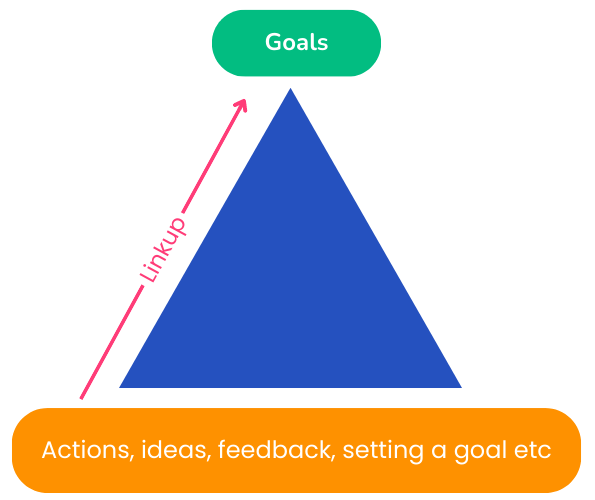
The Linkup technique as mentioned in the Leader Lab, can help you strategically keep progress, ideas, and decisions aligned with the overall goal.
If you imagine a triangle with your goal at the top, the Linkup is connecting our actions(at the bottom) to the goal (at the top).
So if team members come to you with an idea(the what), but not the reason(the why) you can ask Linkup questions, like "What do you hope to achieve?", that help your employees connect with the goal at the top.
In the same way, you can link up the Why whenever you make a request, ret a goal, delegate or give feedback. Using the why should never be underestimated.
3 reasons to adopt Linkup to you leadership style
- Linkups create alignment faster
Without a clear and explicit linkup, it can be easy to make progress towards different goals and thus expend energy in different directions. A related benefit of linking up is that it can reveal people's assumptions about the best way to achieve a certain outcome. - Linkups enable autonomy
When managers focus on the why (the connection to the goal) rather than the what, they create more autonomy for team members to make decisions. Because they know what goal the decisions should contribute to. Leaders who focus on the what tend to fall into the ditch of micromanagement.
For example: If you tell your team that their conference budget is capped at 100,000 because the goal is to get a 20% return on ticket sales, the team can make autonomous decisions on how to allocate the budget without having to ask the manager every time they need to spend money.
- Linkup get you Buy-in Faster
"Because" has power. When people understand what's at the top of the triangle, they make better decisions and are more motivated to act.
Linkup-typer
You can use Linkup in different contexts. Here are some Linkup types from The Leader Lab.
| Framing Linkup |
The reason I ask… |
| Impact Linkup |
The impact of doing this is…. |
| Benefit Linkup |
This will help us achieve…. |
| Outcome Linkup |
The end result should be…. |
| Passion Linkup |
I’m really excited about this because…. |
| Overall Linkup | This links up to… What does this link up to? |
The only bad linkup question is Why? It triggers defensiveness and signal judgement rather than authentic curiosity.
An example
Team member: "Hey, I was thinking that we should really update the landing page on our website."
Team Leader: "Why would we do that?"
