In this section you will find:
Three levels of goal setting
Types of Goals
Having clear goals and attainable targets is a must for any successful team!
Unattainable or unrealistic goals will demotivate and stress your team. Having clear goals and targets gives team members direction and a sense of purpose, and at the same time, establishing reachable milestones provides frequent chances to celebrate, fostering both individual and team satisfaction.
You can look at all three levels of goal setting as one whole process, but sometimes it is enough to look at one or two levels, all depending on the feedback from your team.
Three levels of goal setting
🚀Leadership goals
These are the long-term goals and vision of the company. What you strive towards. Most often, these are goals that span a longer time over several years.
.png) These can be something like "Becoming a key player in our field", "Going public on the stock market" or "Providing the most satisfied customer's in our field". These long-term goals should be made by the leadership according to the resources and the purpose of the organization.
These can be something like "Becoming a key player in our field", "Going public on the stock market" or "Providing the most satisfied customer's in our field". These long-term goals should be made by the leadership according to the resources and the purpose of the organization.
You might already have long-term goals in your company, so this step might not be needed. However, if you don't, you should definitely set aside some time to examine your roadmap, establish goals that are in line with your purpose, and develop a vision for your business.
It helps any organization and its employees to feel that they are a part of a journey, and it strengthens a company's identity.
🧠Team goals
This is an important part that you should focus on. Your team should have its own goals and targets that help the overall long-term goal become a reality. Team goals are most often short-term goals with relevant targets and milestones..png)
These goals are most efficient when they are created in collaboration. It increases ownership and commitment to the goals. It also helps the team culture's trust and cohesion to work together towards goals.
The Process:
- Call in a team meeting.
Inform your team before the meeting that the purpose is to set team goals, and ask them to think about both their own motivation and aspiration as well as the leadership goals or vision of the company. This way, before you start the collaborative brainstorming and goal setting, your team members have already given thought about what could be important next steps. - Find your team goals
Here you come up with goals and decide on which ones you want to achieve within a specific time frame. It could be a month, 3 months, 6 months, etc. It all depends on your team's tasks and work environment. Here you can use, for example, the affinity map technique to get people's ideas down on paper. - Prioritize goals
After you have written all the goals you want to possibly strive for you should prioritize them in the team. This can be done with for example a 100$ technique. Remember to have the overall goal or vision of the company in mind. The goal here is to come to an agreement on which objectives to start with. - Break the goals into smaller targets and milestones.
Make sure that in this discussion you also take some time and think about how the team supports each other in reaching these goals, and what to do when challenges arise.
🏄Individual goals
Here you break down the team goal into smaller work units.
.png) These individual goals can be formulated during the team meeting and often these individual goals happen organically when the team collaborates and prioritizes goals. But if not, you should take the time with individual team members and come up with objectives and tasks for them to work towards.
These individual goals can be formulated during the team meeting and often these individual goals happen organically when the team collaborates and prioritizes goals. But if not, you should take the time with individual team members and come up with objectives and tasks for them to work towards.
Make sure to encourage honesty in terms of tasks and deadlines, based on the resources that your team members have. Setting goals with your team members is redundant if they are not realistic and will produce stress rather than serve as motivation.
Sometimes your team members just need clearer individual goals without focusing on the other two levels, and you can make sure you provide individual support by collaborating on goals. But we recommend having thought about all three levels.
FOLLOW UP
When you have set your goals it is an immensely important part of the process to follow up on the progress of your team and team members. You should have regular checkups or status meetings to see if people are succeeding in their goals if they need support or even if the goals need to be adjusted. Decide with your team how often this should happen.
And don't forget the most important part, celebrate and recognize the progress and milestones reached in your team. It is essential, and you and your team will feel appreciated and motivated!🎉
Types of goals
Formulating a goal needs to be realistic and achievable. It won't do much to set the goal of traveling to the moon if your company doesn't specialize in building rockets. We always urge people to shoot for the stars, but just make sure that you have the right tools to get there!
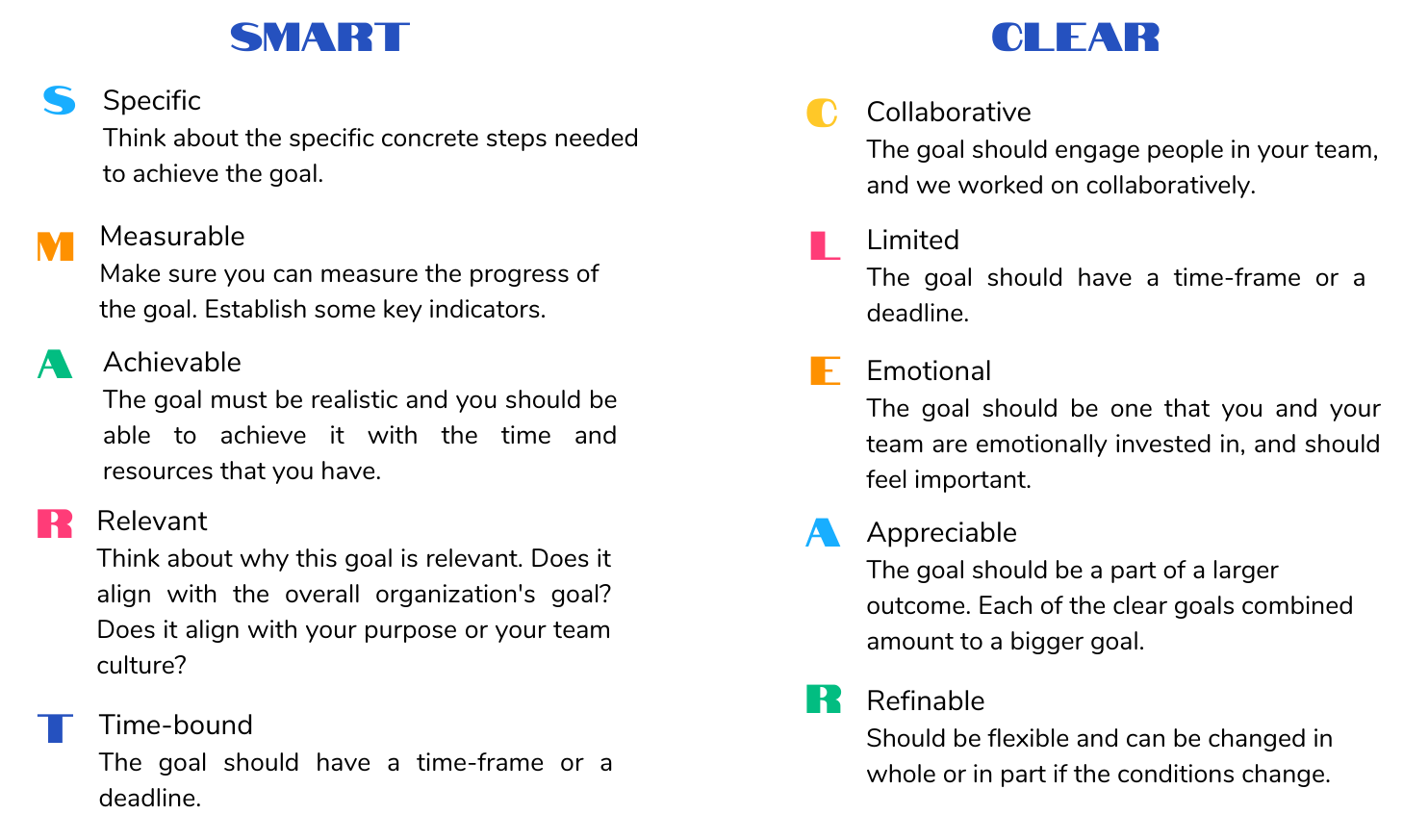
SMART goals vs CLEAR goals
Many have heard of SMART goals, and it is a tried and true best practice in goal setting. CLEAR goals are similar but with a more agile and flexible approach. There are some differences but both overlap in important features, and no matter which approach you take when setting goals, both will provide you with important tools.
.png)
