Types of mentoring
Implementing a Buddy program
The Buddy program is also known as mentoring
The purpose of a buddy program is to support the growth and development of your team members and share valuable knowledge by connecting team members to someone senior or expert within or even outside your organization.
Implementing a mentorship might take some time, but don't be discouraged. Supporting team members, cultivating relationships, and encouraging a sharing culture will always help your team in the long run!
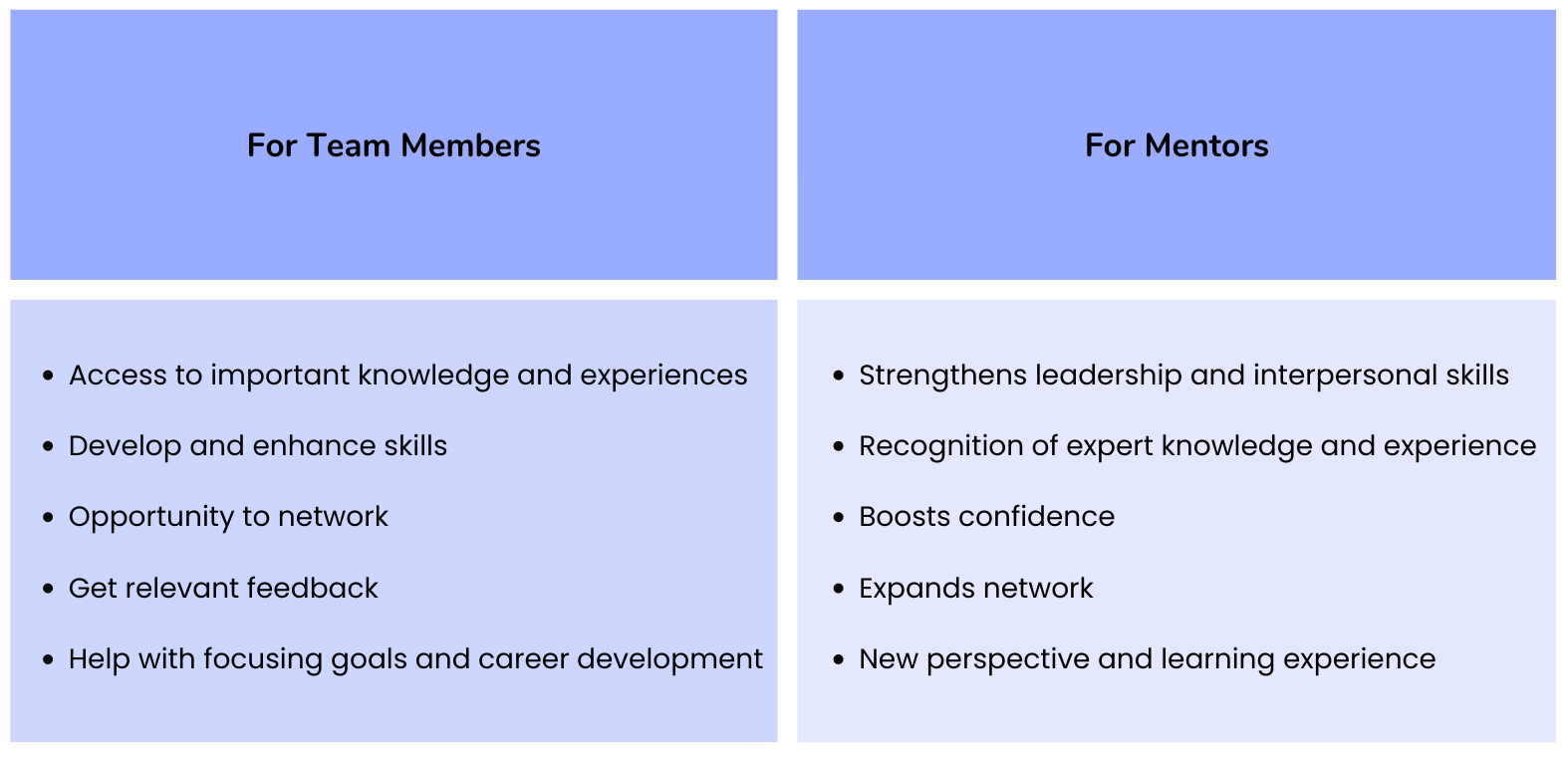
Here are some benefits of mentorship
.png)
Types of Mentoring
The most well-known is 1-on-1 mentoring, but you can also do group mentoring, virtual mentoring, or even reverse mentoring.
- 1-on-1 is the most well known where your mentor and mentee engage in a continuous 1-on-1 relationship where they focus on goals and skills the team member wants to develop, giving continuous feedback and sharing relevant knowledge
- Group mentoring could be implemented where, for example, there is a short supply of mentors or you want to mentor your team in a specific skill or capability. It is conducted in a more coaching capacity, and less focused on building a close relationship between the mentor and each mentee.
- Reverse mentoring is where you have a junior employee mentor a senior employee. This can be employed in different circumstances. For example, implementing new technological practices where the junior is more knowledgeable than a senior employee. Or to give people of minority groups an opportunity to share their experiences with senior employees.
Implementing a Buddy Program
Here is a best practice for implementing your Buddy Program
1. The goal of the Buddy Program
.png) When you implement a Buddy program, it is vital to have a clear purpose for mentoring. It should have specific goals or targets and be based on your resources.
When you implement a Buddy program, it is vital to have a clear purpose for mentoring. It should have specific goals or targets and be based on your resources.
You should ask these questions:
- What change do we want as a result of the mentoring in terms of growth and development?
- What resources do we have to make it happen? In terms of knowledge, people, tools, and how do we achieve measurable and meaningful results?
- How does our context influence the way we mentor? For example, your industry, workload, company culture, values, etc.
2. Finding the right person
When doing a Buddy Program, it is very important to find the right person to mentor. Here are three ways to find the right person.
.png) Word-of-mouth
Word-of-mouth
A very effective way is to directly ask people you might feel are a good fit to be a mentor. People are more inclined to respond positively to becoming a mentor when asked by someone they know.
Team members identify possible mentors.png) Team members sometimes already have in mind a person they are inspired by or want to learn from and interact with. So it can be very effective to involve the team members in finding the right person.
Team members sometimes already have in mind a person they are inspired by or want to learn from and interact with. So it can be very effective to involve the team members in finding the right person.
.png) Open calls and consistent messaging
Open calls and consistent messaging
If you make an open call for mentors, communicate the message often in your organization. Possible mentors sometimes need to see requests for mentors up to three times before they decide to come on board. So make sure that if you are calling for mentors, you have a consistent and repeated message in a place where people can see it.
3. Preparing team member and mentor
.png) Talking with the team member before the mentorship starts is a good opportunity to discuss and reflect on their motivation, expectations, and how long the mentorship lasts. Discuss commitment, benefits, possible challenges, and what actions you want to take if they arise.
Talking with the team member before the mentorship starts is a good opportunity to discuss and reflect on their motivation, expectations, and how long the mentorship lasts. Discuss commitment, benefits, possible challenges, and what actions you want to take if they arise.
The same process goes for the mentor, where you can discuss their expectations, commitment, and goals. It is also an opportunity for you as a leader to understand what type of process your mentor has in mind for helping the team member grow. That way, you can better know where or if you can offer support.
4. Follow-up and support
.png) You should give the mentor and team members full autonomy over the actual mentoring process. It will lose its purpose if leaders micromanage it.
You should give the mentor and team members full autonomy over the actual mentoring process. It will lose its purpose if leaders micromanage it.
However, it is beneficial to have follow-ups to see how the mentorship is going, and you should do so regularly. It is an opportunity to see how it is progressing and to offer support and resources or address concerns.
5. Closure
.png) When the mentorship ends, it is important to have a separate discussion with the mentor and team member and reflect on the results, how it went, what went well, and what could be improved. That way, you have the opportunity to continuously improve the way you do the Buddy Program!
When the mentorship ends, it is important to have a separate discussion with the mentor and team member and reflect on the results, how it went, what went well, and what could be improved. That way, you have the opportunity to continuously improve the way you do the Buddy Program!
